

 Українська
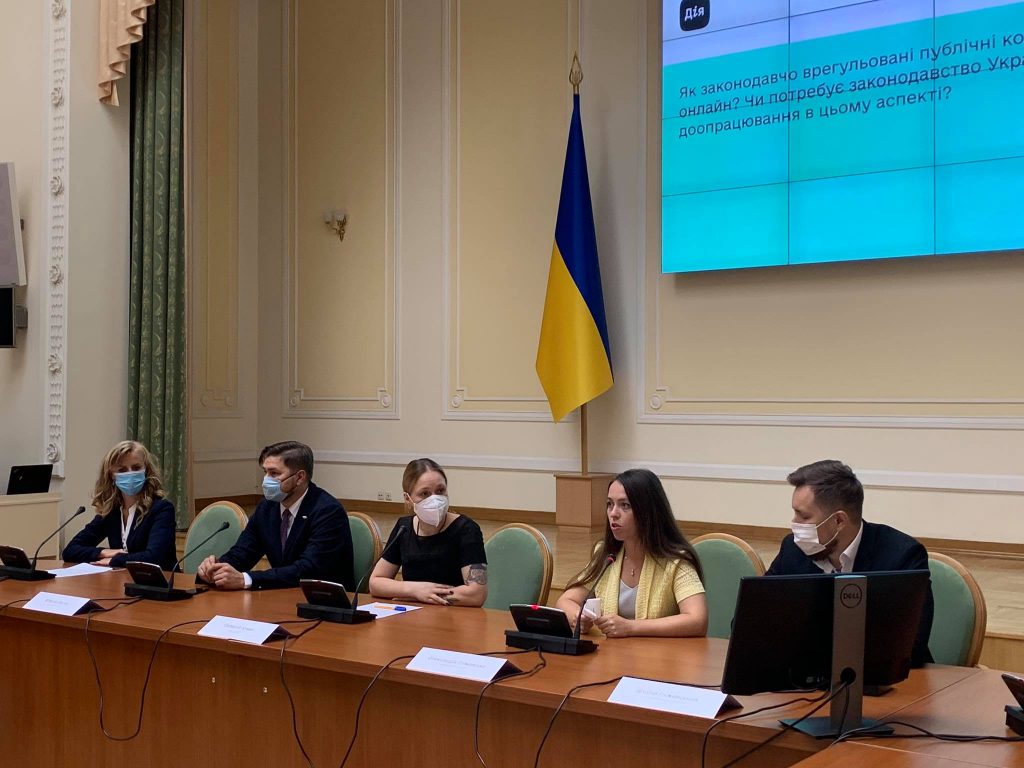
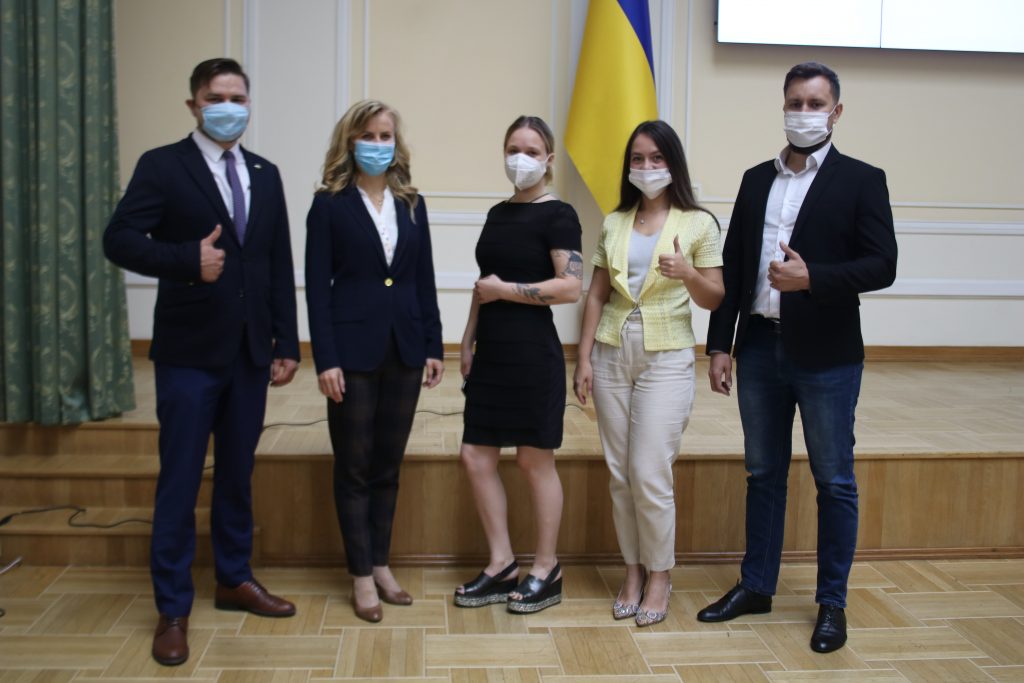
On September 17th, the platform “Diia. Digital Education” [‘Diia’ means ‘Action’ in Ukrainian – ed.] held a presentation of the new educational series “Public Consultations Online”.
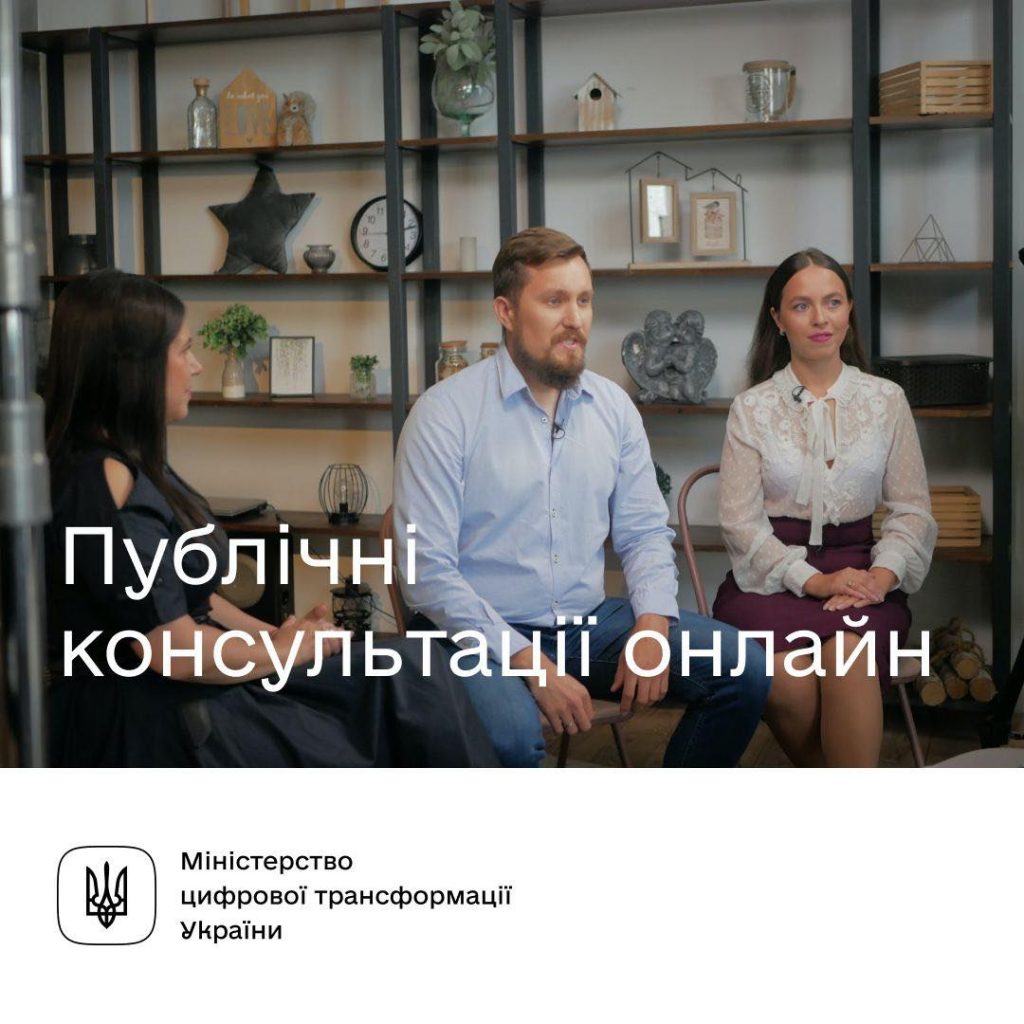
About the educational series “Public Consultations Online”
One of the most effective tools for building trust between the government and the citizens is public consultation. It has several formats, but one of the most efficient, especially in the times of quarantine restrictions, is the online format. This series is for those who want to organize public consultations and take part therein.
About the Project “Diia. Digital Education”
The Ministry of Digital Transformation of Ukraine has a strategic goal: to teach 6 million people digital literacy in 3 years. To achieve this goal, it launched the Project “Diia. Digital Education” consisting of 2 components: the first one is an educational platform with a series on digital literacy for different segments of the audience. The second component is a network of hubs providing an opportunity to connect to the Internet with gadgets available for anyone. As of now, 27 different series have already been recorded, including the series “Public Consultations Online”. The series was created jointly by the “Eidos” Center, the “Institute Respublica” and All-Ukrainian Initiative “Active Community”, and the Ministry of Digital Transformation.


Oleksandra Hlizhynska, Executive Director of the “Institute Respublica” and a co-founder of the All-Ukrainian Initiative “Active Community”:
“Speaking of the public consultations offline, they only somewhat different from those held online. Currently, a system like ZOOM allows one to hold events in a realistic way, similarly to the ones that we can hold ‘live’. However, live events feature a personal, warmer contact. Some citizens prefer such traditional methods of communication. At the same time, the pandemic has strongly affected the way we should communicate in the new environment and pushed us to online communication. The All-Ukrainian Initiative “Active Community”, with the support of the NDI, held more than 60 different public consultations in more than 30 communities throughout Ukraine. Most of them were held online. There is a good tool called “Your Opinion”, using which one can quickly and easily organize a public consultation at the community level, at the city level. The authorities can consult citizens on issues that can involve local residents. Additionally, not only the citizens need to prepare for public consultations but the public authorities as well. Therefore, for our part, we advise and assist the authorities. Information support during online events is also extremely important. There are two goals: to attract the maximum number of citizens and residents and to sparkle their interest to take part in the public consultation. On the other hand, it is necessary to explain the topic in a quality manner, to convey information, to offer different solutions to certain problems. When a resident is well acquainted with the issue discussed at a public consultation, he can assess his personal gains from the decision in his community. In Drohobych, we held a public consultation to select the slogan that would best represent the city. After the public consultation was completed, the authorities immediately presented the decision to the citizens and now everyone knows that “Drohobych is where the salt is” [pun in Ukrainian: salt also means ‘point’ – ed.].
Most people are concerned with the issues of utilities, medicine, landscaping, social infrastructure, and transport. There is a certain category of issues that should be brought to a series of separate consultations. Simpler questions are easy to pose with “Your opinion”.
For example, in Uzhhorod, citizens were asked what the city logo should look like. What motivates citizens to join public consultations? The reason is that, in a month or two, they already see changes for better.”

Vitalii Hlizhynskyi, the manager of the Project “Public Consultations with Ministries”:
“Currently, we see a large number of different reforms going on in the country. Those reforms are often incomprehensible for many citizens. Ministries also feel that people are not very supportive of good reforms, causing the reforms to pass slower than one would like. Ministries understand the need to communicate with people, to talk to them about the advances and the implementation of these reforms, and to engage them through interesting ideas regarding these reforms. Those, who will be assigned with the task of implementing the reforms, can best tell how to put down the specific provisions in a document so that the instructions for their implementation are practicable. We cooperate with a number of ministries: the Ministry of Health, the Ministry of Education and Science, the Ministry of Social Policy. We have experience working with the Secretariat of the Cabinet of Ministers within the framework of the ‘Open Government’ Initiative and with the Ministry of Communities and Territories Development. All these consultations were aimed at hearing the opinion of citizens on how to best develop a certain direction of reforms. We would be very happy to work with the Ministry of Digital Transformation.
As regards the establishment of cooperation with the ministries: their representatives have been reiterating that it is necessary to develop internal communication. The public consultations may raise issues affecting 2 ministries at the same time. For example, the Ministry of Education and Science holds a public consultation on the development of preschool education and the issue of healthy nutrition in kindergartens arises. And this is already a matter for the Ministry of Health to regulate. One ministry can hardly solve the issue in a quality manner. This is the point where the cooperation is needed, and where public consultations should be held at the level of two ministries. Establishing public consultations at different levels will definitely improve the communication and the quality of the public policy.”
The series is already available at the portal “Diia. Digital Education”.
The series can be watched at the link: https://osvita.diia.gov.ua/courses/e-consultations
For reference. The Project is implemented by the Ministry of Digital Transformation of Ukraine in partnership with the NGO “Eidos” Center and within the USAID Project “Support to Anti-Corruption Champion Institutions” (SACCI), and with the participation of the “Institute Respublica” and All-Ukrainian Initiative “Active Community”.
Note. The mission of the “Active Community” is to achieve prosperity through the democratic development of Ukrainian communities. The goal for 2025 is to activate and involve at least 1% of citizens in decision-making and promotion of reforms in Ukraine on a systemic basis for the well-being of Ukrainian communities. The initiative was created through the activities of the “Institute Respublica”. We are working to increase the civil activity of citizens.
Author: the head of the press service of the “Institute Respublica” and the All-Ukrainian Initiative “Active Community” Tetiana Kavunenko


