

 Українська
On October 28th, 2020, the Constitutional Court of Ukraine (CCU) published the text of the decision to abolish the Criminal Code article on false information in declarations of assets. The respective decision was published on the CCU website and adopted by the CCU’s Grand Chamber comprising 15 judges.
In addition to the article on false information in declarations, the CCU declared the verification of electronic declarations of assets unconstitutional and revoked the right of the National Agency on Corruption Prevention (NACP) to verify declarations and identify conflicts of interest.
The decision states that it is “binding, final and not appealable”.
On October 30th, the All-Ukrainian Initiative “Active Community” supported the protest rally “Let’s send the CCU judges to Rostov”.

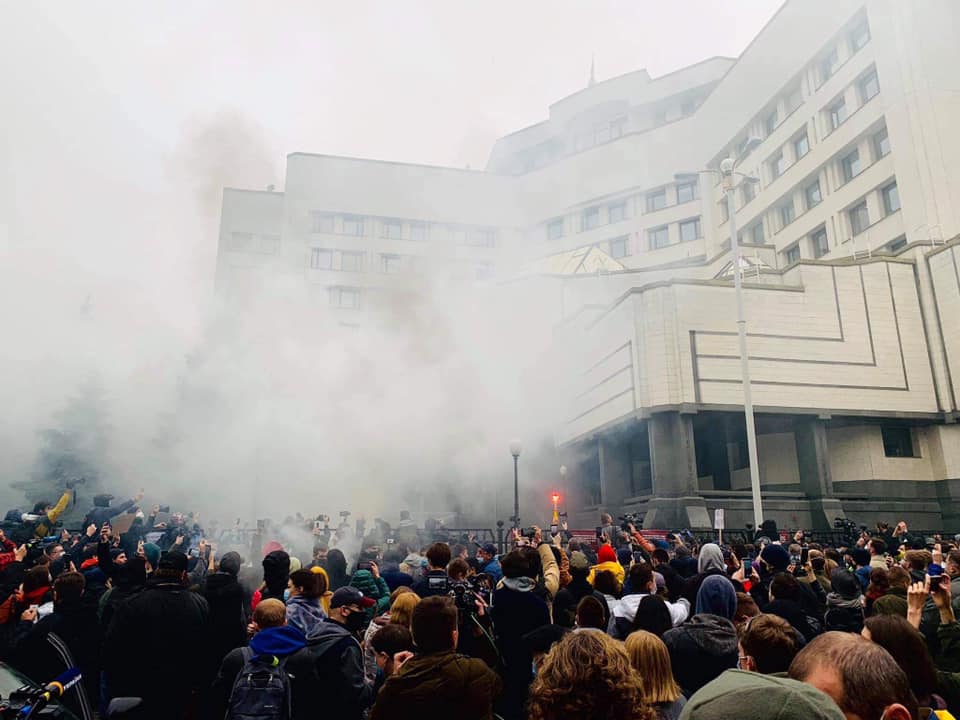
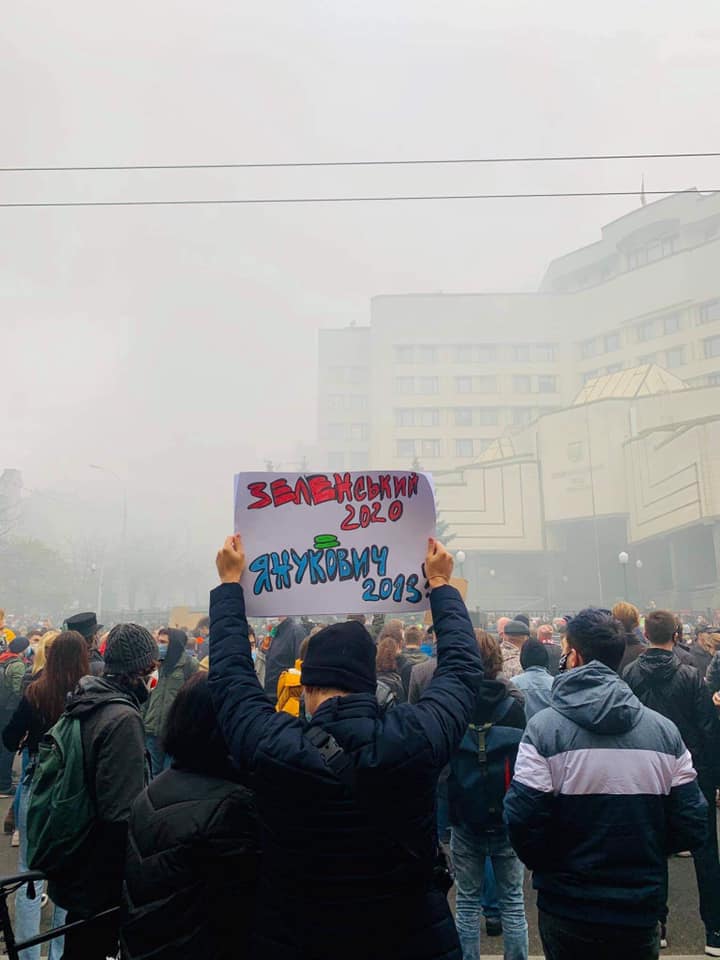
Hundreds of activists, journalists and concerned citizens gathered by the CCU building to express their position regarding the Constitutional Court’s decision to abolish liability related to e-declarations.
We have also held an information campaign “Stop the Arbitrariness of the CCU!”. The purpose of the campaign was to demonstrate the main provisions of the decision and their possible consequences for Ukraine.
The main provisions of the CCU’s decision to abolish e-declaration and the consequences it might cause:
The key points in the recent ruling by the Constitutional Court of Ukraine are the abolition of criminal liability for declaring false information, the closing of declarations of state officials from journalists and the public, and a significant reduction of the NACP’s powers.
The document, in particular, stipulates that the Constitutional Court declared unconstitutional Article 366-1 of the Criminal Code of Ukraine, which had provided for liability for declaring false information.
Furthermore, the CCU also abolished two main powers of the National Agency on Corruption Prevention (NACP): to monitor and to exercise control over the implementation of legal acts on ethical conduct, prevention and settlement of conflicts of interest in the activities of persons authorized to discharge functions of the state or local self-government bodies and equal-status persons;
to control and to verify the declarations of declarants, to store and to publish such declarations, to monitor the lifestyle of declarants.
Besides, the CCU revoked the NACP’s right to draw up administrative offence reports.
It also recognized unconstitutional a number of articles of the Law on Prevention of Corruption, in particular:
Article 48 (control and verification of declarations);
Article 49 (verification of timeliness of declaration filing);
Article 50 (full verification of declarations);
Article 51 (lifestyle monitoring of declarants);
Article 65 (liability for corruption or corruption-related offences).
For its part, the NACP stated that the anti-corruption system had been damaged and the following consequences might occur:
electronic declarations, as a matter of fact, cannot be verified;
thousands of persons, who have committed corruption offences, would be released from responsibility;
the NACP is prohibited to consider reports on corruption offences, thus, the issue of whistleblowers is also affected;
it is practically forbidden to bring to administrative and disciplinary responsibility all persons, who have committed corruption offences, and those, who hold a responsible and especially responsible position (judges, prosecutors, members of Parliament, etc.);
– The NACP is not able to check the reports by political parties, including the persons who fund them.
– Among other things, the decision of the CCU would also bring about the termination of all criminal proceedings initiated under Article 366-1. As of October 27th, 2020, the National Anti-Corruption Bureau of Ukraine (NABU) had been investigating 180 cases of false information in declarations. Seven people, including three former MPs, had been handed over the statements of charges. 34 indictment acts were submitted to the courts, 6 of which resulted in court sentences.
The decision could also cause obstacles to the appointment of local elections winners. The CCU, by its decision, denied access of the NABU to state registers, which are necessary to conduct background checks related to declarations of assets of candidates for top positions at public authorities. As the NACP’s press service explained, not a single head of a state body can be officially appointed without such check. The agency stressed that the CCU’s decision effectively blocked the appointments based on the results of the local elections.
So, why the electronic declaration is the public good, and what did the CCU rob us of by its decision?
The National Agency on Corruption Prevention (NACP) was forced to close the access to declarations of officials for the public and is not unable anymore to initiate criminal proceedings against judges for concealing their assets.
Thus, the decision by the CCU downplays the achievements of the anti-corruption reform, since the introduction of the electronic declarations system is a key accomplishment of Ukraine after the Revolution of Dignity.
The E-declaration was launched in Ukraine in 2016 and it was a breakthrough in the anti-corruption reform.
The National Anti-Corruption Bureau of Ukraine (NABU) stated that, by introducing the e-declaration system, Ukraine followed the best practices of developed western countries, where declarations of assets are an element of political culture and respect for citizens.
The effectiveness of this instrument is determined by the degree of responsibility for its violation, which the CCU’s decision actually undermined. This dealt a devastating blow to an efficient tool for rooting out the corruption in the government.
The main task of the electronic declaration system is ensuring transparency and accountability of the public service. That is, thanks to the declarations of assets, we can see whether an official’s income corresponds to his actual lifestyle.
The NACP notes that the innovativeness of the electronic declaration system rested on three pillars: openness, comprehensiveness and responsibility.
Openness implied that anyone could see an official’s declaration 24/7 in the Unified State Register of Electronic Declarations.
Comprehensiveness provided for a list of information to be declared, including the savings in the form of cash, intangible assets, construction in progress, valuable movable property, ownership of shares and corporate rights, and final beneficiary. Without the entirety of this information, it is impossible to establish the aforementioned discrepancies.
Responsibility stipulated sanctions for declaring false information and violating the rules of electronic declaration. The approach to proving illicit enrichment was also altered and linked to the information contained in electronic declarations.
What does the society lose along with the declarations?
Since the spring of 2020, the NACP has revealed 497 million hryvnias of assets as false information in the declarations of officials!
This would not have happened but for the NACP’s authority to store, verify and publish the declarations of officials, and also the access to all the Registers required for such verification. This money could potentially be returned to the budget of Ukraine and used for the needs of the society, such as schools and hospitals. But now, this will not happen. Besides, corrupt officials received a cart blanche to lie in the declarations, because the NACP will not be able to verify this.
How does the Constitutional Court of Ukraine explain its decision to abolish criminal liability for false information in e-declarations?
The Constitutional Court put its decision down to the fact that the former powers of the NACP used to allow the agency to affect the judges, including judges of the Constitutional Court. And this implies the “control of the executive branch over the judiciary”. The Constitutional Court does not completely deny the need for declarations of assets but requires the adherence to the principle of judicial independence.
“Having examined the corpus delicti provided for in Article 366-1 of the Criminal Code of Ukraine, the Constitutional Court of Ukraine concluded that the use of statutory concepts that lack a clear list of applicable laws makes it impossible to unambiguously define the range of subjects of the crime and the reference rules make it impossible to establish the range of their addressees,” the Court stated.
Four judges of the Constitutional Court opposed the Court’s decision: Serhiy Holovatyi, Oleh Pervomaiskyi, Viktor Kolisnyk and Vasyl Lemak. Judge Serhiy Holovatyi has already submitted his dissenting opinion, and Judge Vasyl Lemak has announced that he would present his one as well.
Mr.Holovatyi believes that the arguments of the Constitutional Court are legally incapable, the NACP does not put pressure on the judiciary, and criminal liability for failure to submit a declaration is fully justified.
In turn, Judge-Rapporteur of the CCU Ihor Slidenko, commenting on the decision to the Information Agency “RBC-Ukraine”, stated that the CCU had abolished the electronic declaration system to protect judges from pressure on them by the executive branch. According to him, the Court could not separate in its decision the right not to check only the declarations of judges, so it had to abolish this provision for all the categories of officials. He also noted that only a judiciary body should have the right to control judges.
“It would take up some time until the legislator resolves the issue. Yes, now, in fact, these provisions (related to checking of declarations – ed.) do not apply to anybody because the legislator formulated the provision is such a way that it cannot be separated for different categories,” Mr.Slidenko noted.
The response of the international community to the decision of the Constitutional Court of Ukraine to abolish liability for false information in e-declarations
The G7 ambassadors (USA, Japan, Germany, Great Britain, France, Italy, Canada) held a meeting with Dmytro Razumkov, the Speaker of the Verkhovna Rada, where the G7 stressed the need for a swift action to resolve the situation and strengthen the anti-corruption bodies in Ukraine.
“Quick action is needed to resolve the crisis, then concerted efforts must be taken to further strengthen Ukraine’s anti-corruption institutions and establish a judicial system that wins the confidence of the Ukrainian people,” the G7 ambassadors stated.
The European Union expressed concern over the recent decision by the Constitutional Court of Ukraine on the activities of the anti-corruption bodies and stressed that it might be the ground for a temporary suspension of the visa-free regime. This was noted in a letter by Mykola Tochytskyi, the Head of the Mission of Ukraine to the EU, to Olha Stefanishyna, the Deputy Prime Minister for European and Euro-Atlantic Integration of Ukraine.
“As our contacts unofficially note, the decision of the Constitutional Court of Ukraine No. 13-r/2020, which abolished the key anti-corruption powers of the NACP and criminal liability for false information in declarations, is a sufficient ground for the European Commission to launch the mechanism of temporary suspension of the visa-free regime,” the letter reads.
Gianni Buquicchio, the President of the Venice Commission, offered to President of Ukraine Volodymyr Zelenskyy the expertise of the Venice Commission in the situation in Ukraine after the notorious decision of the CCU.
German MEP Viola von Cramon believes that the absence of anti-corruption bodies in Ukraine would initiate the “respective provisions” of the Association Agreement and threatens the visa-free travel. According to her, corrupt judges in Ukraine have destroyed the anti-corruption institutions.
Peter Stano, the EU Lead Spokesperson for Foreign Affairs and Security Policy, stressed that the CCU’s decision calls into question a number of international commitments that Ukraine has undertaken regarding its international partners.
The European Union stated that Ukraine should:
restore the legislation on electronic declarations of assets and the respective responsibilities of the National Agency on Corruption Prevention;
to stabilize the legal status of the National Anti-Corruption Bureau of Ukraine by December 16th, the deadline established by the Constitutional Court.
The previous decisions by the CCU adopted on the anti-corruption reform in Ukraine
Note. The mission of the “Active Community” is to achieve prosperity through the democratic development of Ukrainian communities. The goal for 2025 is to activate and involve at least 1% of citizens in decision-making and promotion of reforms in Ukraine on a systemic basis for the well-being of Ukrainian communities. The initiative was created through the activities of the Institute “Respublica”. We are working to increase the civil activity of citizens.
Authored by
Tetiana Kavunenko, the head of the press service of the Institute “Respublica” and the All-Ukrainian Initiative “Active Community”


